Blogs
What is Buckling of Nasal Septum? Causes and Treatment
Buckling of nasal septum is a condition where the thin wall of bone and cartilage that divides the nasal cavity bends, twists or bows off the center line. This structural deformity narrows one or both nasal passages and can interfere with normal airflow during breathing.
Many people live with minor septal buckling and never notice it. The problem becomes clinically relevant when the bend is sharp or positioned in a way that blocks the airway, dries the nasal lining or distorts the external shape of the nose. At Ascent Hospital, the best ENT hospital in Kerala specialists evaluate septal buckling not just as an anatomical finding but as a functional issue that affects sleep, exercise tolerance and sinus health.
A deviated nasal septum may present as a simple tilt, a sharp spur or a true buckle and each pattern creates different symptoms and requires a different surgical approach.
What Buckling of Nasal Septum Actually Means
Buckling of nasal septum is not simply crooked. The term refers to a specific mechanical failure pattern where the cartilage folds or kinks under compressive force rather than shifting as a flat plane. Think of a playing card pressed from both ends: at first it bows, then it snaps into a sharp bend. Nasal cartilage behaves similarly when growth forces or trauma exceed its structural tolerance.
The buckle can be C-shaped, S-shaped or localized to a single hinge point. In some patients the entire quadrangular cartilage folds like an accordion. In others only the caudal edge, the part nearest the nostril opening, collapses inward.
Buckling vs. Tilt vs. Spur
Patients often use the term deviated septum loosely, but surgeons distinguish between three patterns because each affects breathing differently and dictates a different correction technique.
| Pattern | Description | Common Symptom | Typical Correction |
|---|---|---|---|
| Tilt | Whole septum leans to one side as a flat structure | Unilateral blockage | Septal repositioning or scoring |
| Spur | A sharp bony or cartilaginous projection at a suture line | Point obstruction, crusting, bleeding | Spur resection |
| Buckle | A fold or kink within the cartilage itself | Bilateral or valve-level obstruction | Cartilage scoring, splinting or excision |
A spur often causes localized irritation and recurrent nosebleeds because dry air strikes the projection directly. A buckle tends to cause more diffuse obstruction because the folded segment reduces the cross-sectional area of the airway over a longer distance.
Why Nose Cartilage Buckles
The nasal septum grows faster than the surrounding facial skeleton during childhood and adolescence. When the septal cartilage outgrows the space available between the palate and the skull base, it must either bow or buckle to fit. This is the most common developmental mechanism.
Trauma is the other major cause. A direct blow to the nose can fracture the bony septum, tear the cartilage from its attachments or create a greenstick-type fold in the cartilaginous plate. Birth trauma can also shift or fold the infant septum and some patients carry that deformity into adulthood without ever recalling an injury.
Where the Buckle is Matters
The location of the fold determines the symptom pattern. A buckle high in the nasal vault near the internal nasal valve produces disproportionate obstruction because this is the narrowest part of the airway. Even a small fold here can collapse the valve during inspiration, especially when the patient breathes forcefully during exercise or sleep.
A buckle in the mid-septum may cause less obstruction but more turbulence, leading to dryness, crusting and recurrent epistaxis. A caudal buckle near the columella can visibly distort the nasal tip and may require an open approach to correct properly.
How Surgeons Correct Buckled Cartilage
Septoplasty for a buckled septum is different from septoplasty for a simple tilt. The surgeon must release the intrinsic tension within the cartilage, not just move it. Common techniques include scoring the concave side of the fold to allow the cartilage to straighten, placing thin cartilage grafts to reinforce weak areas or excising a small wedge at the hinge point.
In some cases the buckled segment is too damaged to salvage and the surgeon replaces it with a harvested piece of septal or auricular cartilage. The goal is always a straight, stable septum that preserves enough support to prevent saddle deformity or nasal valve collapse.
An experienced ENT specialist in Kerala will assess not just the septum in isolation but the entire nasal framework, including the turbinates, the valve angle and the external nasal bones. Correcting a buckle without addressing an enlarged inferior turbinate may leave the patient still obstructed.
Buckling of Nasal Septum in Children and Teens
Septal surgery in growing patients requires caution. The septum contributes to midface growth and aggressive cartilage resection in a child can impair nasal and maxillary development. Most surgeons defer septoplasty until growth is largely complete, typically in the mid to late teens, unless the obstruction is severe enough to affect sleep, school performance or facial development.
In younger children, a conservative cartilage-sparing approach may be used. The best ENT surgeon in Kerala will weigh the functional benefit against the risk of growth disturbance and often chooses a limited procedure that straightens without resecting.
When to Seek Evaluation for Buckling of Nasal Septum
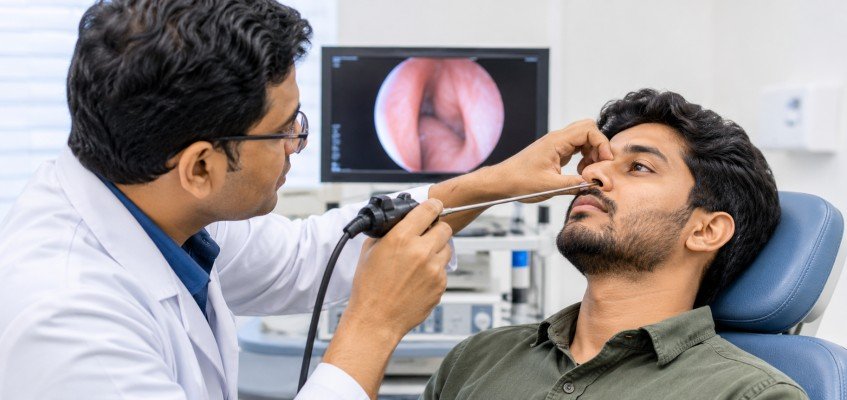
Persistent one-sided nasal obstruction, mouth breathing at night, recurrent sinus infections or frequent nosebleeds on one side warrant an endoscopic evaluation. A simple anterior rhinoscopy in a clinic can miss a posterior buckle, so a nasal endoscopy is the standard diagnostic tool. The best ENT hospital in Kerala offers comprehensive nasal airway assessment including endoscopic evaluation and, when needed, imaging to map the septal contour before surgery.
Patients near Malabar region or central part of Kerala can visit Ascent ENT hospital Perinthalmanna, Ascent ENT Hospital in Calicut or Ascent ENT hospital Palakkad and access full septal evaluation and surgical care without traveling to a metropolitan center. The department also manages related conditions of the Throat Head and Neck region, making it a practical choice for patients with combined airway complaints.
Schedule your consultation with us to examine by an ENT specialist to determine whether your septal buckle is contributing to your symptoms and which correction approach fits your anatomy.
Frequently Asked Questions
1. What does a bent septum mean?
A bent septum means the nasal partition has shifted, folded or curved away from the midline, often narrowing one or both breathing passages.
2. Can a buckled or deviated septum cause nasal valve collapse?
Yes, a buckled or deviated septum can destabilize the internal nasal valve and contribute to its collapse during inspiration, especially when the deformity lies near the valve angle.
3. How can I test for a buckling of nasal septum?
A simple home check involves breathing through each nostril separately while blocking the other, but only a nasal endoscopy performed by a specialist can confirm the diagnosis and map the deformity.
4. Does a buckling of nasal septum always need surgery?
No, mild buckling without significant obstruction or recurrent symptoms can be managed with observation, saline irrigation and treatment of any associated nasal inflammation.
Share
 (1) (2).png)


Our Professionals
Dr. Sharafudheen. P.K
Chief Consultant ENT & Cochlear Implant Surgeon
MBBS, MS (ENT), DORL DOHNS - RCS Ed (UK)
 (2).jpg)
Dr. Anuradha Varma. M.R
Senior Consultant ENT, Head & Neck Surgeon
MBBS, DLO
.jpeg)
Dr. Bijiraj Vathwam Veettil
Senior Consultant ENT Head & Neck, Sleep Surgeon
MBBS, MS (ENT), Fellowship in Snoring and Sleep apnea Surgeries (Singapore), Fellowship in sinus and skull base surgery
.png)
Dr. Prasanth Parameswaran
Senior Consultant ENT, Head & Neck Surgeon
MBBS, DLO, DNB (ENT), MNAMS, AASC (Specialist - Allergy and Immunotherapy), Fellowship in Snoring and Sleep apnea Surgeries (Singapore).

Dr. Arshad M Razi
Consultant ENT, Head & Neck Surgeon
MBBS, MS (ENT), Fellow in Head & Neck Surgical Oncology

Dr. Deepthi. N.V
Senior Consultant ENT, Head & Neck Surgeon
MBBS, DNB (ENT)


Dr. K Shilpa Nair
ENT Surgeon | Cochlear Implant & Sleep Surgery Specialist
MBBS, MS, DNB, MRCS(Eng), Post doctoral Fellowship in Implantation Otology


Dr. Nibi Shajahan
Consultant ENT, Head & Neck Surgeon
MBBS, MS (ENT), Fellowship in Snoring and Sleep apnea Surgeries (Singapore). Trained in Allergy and Immunotherapy



Dr.Anand Krishnan
Consultant ENT, Head and Neck Surgeon
MBBS ,DLO ,DNB ENT ,MRCS (ENGLAND)




Dr. Seshadri Ganesh. A.L
Senior Consultant Anaesthesiologist
MBBS, DCH, MD, DIP.N.B




Mr. Prasanth. N.P
Senior Audiologist & Speech Language Pathologist
BASLP, MASLP, MSc (Psy)

Ms. Chinju Johny
Audiologist & Speech Language Pathologist
BASLP, MSc (Audiology)



Our Patient Stories
View All Testimonials