Blogs
Thyroid Nodule vs Goiter: Key Differences and Treatment Options
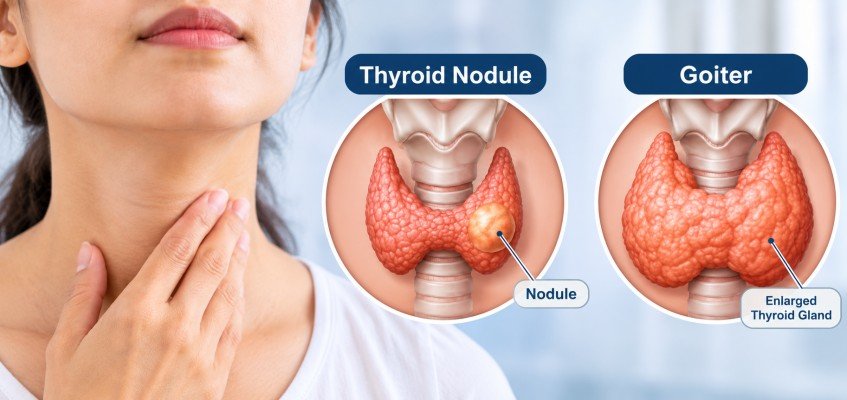
A thyroid nodule is a discrete lump or localized growth within the thyroid gland, while a goiter is an overall enlargement of the entire thyroid gland. One describes a specific spot, the other describes a general swelling. Both can occur together, which is why the distinction often confuses people. Understanding thyroid nodule vs goiter starts with knowing whether the swelling is limited to one area or involves the entire thyroid gland.
At Ascent Hospital, the best ENT hospital in Kerala patients frequently arrive after noticing neck swelling and are unsure whether they have a nodule, a goiter or both. The practical difference matters because the evaluation, follow-up and treatment can differ. This article explains how these two conditions overlap, how they differ and what steps make sense if you have either finding.
Thyroid Nodule vs Goiter: Understanding the Differences
The thyroid sits at the front of the neck, just below the voice box. A goiter means the whole gland has grown larger than normal. A nodule means one area within the gland has formed a lump, which may be solid, fluid-filled or a mix of both. Some people have a smooth goiter with no distinct lumps. Others have a single nodule in an otherwise normal-sized thyroid. Many have a multinodular goiter, where the gland is enlarged and contains multiple lumps.
| Feature | Thyroid Nodule | Goiter |
|---|---|---|
| Definition | Localized lump within thyroid tissue | Enlargement of the whole thyroid gland |
| Texture | May feel like a single firm spot | May feel smooth or irregular, depending on cause |
| Hormone levels | Usually normal, sometimes high or low | Often normal, but can be high or low |
| Cancer risk | Over 90% are benign | Low overall, but nodules within a goiter need evaluation |
| Common causes | Cell overgrowth, cysts, inflammation, rarely cancer | Iodine deficiency, autoimmune disease, nodules, thyroiditis |
When comparing thyroid nodules vs goiter, the main difference is the pattern of growth. A nodule affects a specific area, while a goiter involves enlargement of the thyroid gland.
What Causes Thyroid Nodules and Goiters?
This is another important factor when understanding thyroid nodule vs goiter, as both conditions can have different underlying causes and may require different treatment approaches. Goiters often develop because the thyroid is working harder than usual. Worldwide, iodine deficiency is the leading cause, though it is uncommon in Kerala and the rest of India where iodized salt is widely used. Autoimmune conditions are a more typical cause here. Hashimoto’s disease can enlarge the gland while causing low hormone levels. Graves’ disease can enlarge it while causing high hormone levels.
Thyroid nodules arise from localized cell growth. Most are benign adenomas, colloid nodules or cysts. A smaller number are cancers. The key point is that a nodule does not automatically mean cancer and a goiter does not automatically rule it out. An ENT specialist in Kerala can help determine which findings need further testing and which can be safely monitored.
Symptoms of Thyroid Nodules and Goiters
In thyroid nodule vs goiter cases, the presence or absence of symptoms does not always indicate how serious the condition is. Even a painless lump may need medical evaluation. Both conditions may cause no symptoms at all. When they do, the symptoms overlap because both can press on nearby structures. A large goiter or a sizable nodule can cause tightness in the neck, a sensation of a lump in the throat, difficulty swallowing or trouble breathing when lying flat. Voice changes and hoarseness can also occur.
Hormone-related symptoms depend on whether the thyroid is underactive or overactive. Underactive thyroid symptoms include fatigue, weight gain, constipation, dry skin, thinning hair and feeling cold more often. Overactive thyroid symptoms include weight loss, a fast or irregular heartbeat, anxiety, shakiness, sweating and trouble sleeping. A person with a small nodule and normal hormone levels may have none of these.
How are Thyroid Nodules and Goiters Diagnosed?
A proper assessment helps distinguish thyroid nodule vs goiter and identify whether the patient needs monitoring, further testing or treatment. A doctor often detects a goiter or nodule during a physical exam by feeling the neck while the patient swallows. The next step is usually a thyroid function blood test, starting with TSH. An ultrasound then shows whether the gland is diffusely enlarged, contains one nodule or contains several. Ultrasound features such as irregular borders, microcalcifications or tall-than-wide shape help determine whether a nodule needs a fine needle aspiration biopsy.
At Ascent ENT hospital Perinthalmanna, the evaluation follows this same sequence: exam, blood work, ultrasound and biopsy only when ultrasound features warrant it. Most nodules do not need a biopsy.
Treatment Options for Thyroid Nodules and Goiters
The treatment approach for thyroid nodule vs goiter depends on the underlying cause, thyroid hormone levels, ultrasound findings and whether the swelling affects nearby structures. A small goiter with normal hormone levels may need no treatment beyond periodic monitoring. If hypothyroidism is present, thyroid hormone replacement often shrinks the goiter over time. If hyperthyroidism is the cause, medications, radioactive iodine or surgery may be appropriate.
A benign thyroid nodule with normal hormone levels typically needs monitoring with repeat ultrasound. Surgery is considered when a nodule is large enough to cause compressive symptoms, when biopsy results are suspicious or indeterminate or when the nodule continues growing. Hoarseness After Thyroidectomy is a known surgical risk because the recurrent laryngeal nerve runs close to the thyroid gland. Choosing an experienced surgeon reduces this risk.
For patients in northern Kerala, Ascent ENT Hospital in Calicut offers evaluation and surgical management when intervention is needed. The decision to operate is never based on size alone.
Common Misconceptions About Thyroid Nodules and Goiters
One mistake is assuming every neck lump is cancer. Most are not. Another is ignoring a goiter because it does not hurt. Slow growth can still eventually affect swallowing or breathing. A third mistake is skipping follow-up ultrasounds for nodules that were initially benign. A small percentage change over time, and interval growth is one factor that prompts re-evaluation.
Can Thyroid Cause Throat Pain? Yes, though it is less common than pressure or tightness. Acute thyroiditis or a rapidly enlarging nodule can cause pain in the front of the neck that may radiate toward the jaw or ear. Persistent throat pain with a thyroid finding deserves prompt evaluation.
When to Seek Care
See a doctor if you notice visible swelling in the front of the neck, difficulty swallowing, breathing trouble when lying flat, persistent hoarseness or symptoms of thyroid hormone imbalance. People with a family history of thyroid cancer or prior neck radiation should be especially attentive. An ENT clinic in Kerala with experience in Throat Head and Neck conditions can coordinate the right tests without unnecessary delays.
For those near Malappuram or Thrissur districts, Ascent ENT hospital Palakkad and the Perinthalmanna location provide access to thyroid evaluation and surgical care. A best ENT surgeon in Kerala will typically guide patients through a stepwise process rather than recommending surgery immediately for every nodule or goiter.
Schedule a consultation with us if you have a thyroid lump, neck swelling or abnormal ultrasound findings and want a clear plan for what comes next.
Frequently Asked Questions
1. Is a thyroid nodule serious?
Most thyroid nodules are not serious. Over 90% are benign. Seriousness depends on ultrasound features, biopsy results, growth over time and whether the nodule causes compressive symptoms or hormone problems.
2. Can goiter turn into cancer?
A goiter itself is not cancerous, but a goiter can contain nodules and a small percentage of those nodules may be malignant. The goiter does not transform into cancer; rather, a cancerous nodule can exist within an enlarged gland.
3. What is another name for a thyroid nodule?
Thyroid nodules are sometimes called thyroid lumps, adenomas, colloid nodules or cystic nodules depending on their composition. A multinodular goiter refers to multiple nodules within an enlarged thyroid.
4. What is the silent warning of thyroid cancer?
Thyroid cancer often causes no symptoms in early stages. The most common silent sign is a painless neck lump found incidentally on imaging or physical exam. Persistent hoarseness, a fixed hard nodule or enlarged neck lymph nodes are less common but more concerning findings.
Share
 (1) (2).png)
Our Professionals
Dr. Sharafudheen. P.K
Chief Consultant ENT & Cochlear Implant Surgeon
MBBS, MS (ENT), DORL DOHNS - RCS Ed (UK)
 (2).jpg)
Dr. Anuradha Varma. M.R
Senior Consultant ENT, Head & Neck Surgeon
MBBS, DLO
.jpeg)
Dr. Bijiraj Vathwam Veettil
Senior Consultant ENT Head & Neck, Sleep Surgeon
MBBS, MS (ENT), Fellowship in Snoring and Sleep apnea Surgeries (Singapore), Fellowship in sinus and skull base surgery
.png)
Dr. Prasanth Parameswaran
Senior Consultant ENT, Head & Neck Surgeon
MBBS, DLO, DNB (ENT), MNAMS, AASC (Specialist - Allergy and Immunotherapy), Fellowship in Snoring and Sleep apnea Surgeries (Singapore).

Dr. Arshad M Razi
Consultant ENT, Head & Neck Surgeon
MBBS, MS (ENT), Fellow in Head & Neck Surgical Oncology

Dr. Deepthi. N.V
Senior Consultant ENT, Head & Neck Surgeon
MBBS, DNB (ENT)


Dr. K Shilpa Nair
ENT Surgeon | Cochlear Implant & Sleep Surgery Specialist
MBBS, MS, DNB, MRCS(Eng), Post doctoral Fellowship in Implantation Otology


Dr. Nibi Shajahan
Consultant ENT, Head & Neck Surgeon
MBBS, MS (ENT), Fellowship in Snoring and Sleep apnea Surgeries (Singapore). Trained in Allergy and Immunotherapy



Dr.Anand Krishnan
Consultant ENT, Head and Neck Surgeon
MBBS ,DLO ,DNB ENT ,MRCS (ENGLAND)




Dr. Seshadri Ganesh. A.L
Senior Consultant Anaesthesiologist
MBBS, DCH, MD, DIP.N.B




Mr. Prasanth. N.P
Senior Audiologist & Speech Language Pathologist
BASLP, MASLP, MSc (Psy)

Ms. Chinju Johny
Audiologist & Speech Language Pathologist
BASLP, MSc (Audiology)



Our Patient Stories
View All Testimonials