Blogs
Drug-Induced Sleep Endoscopy (DISE): Complete Guide to Diagnosis, Procedure & Treatment of Sleep Apnea
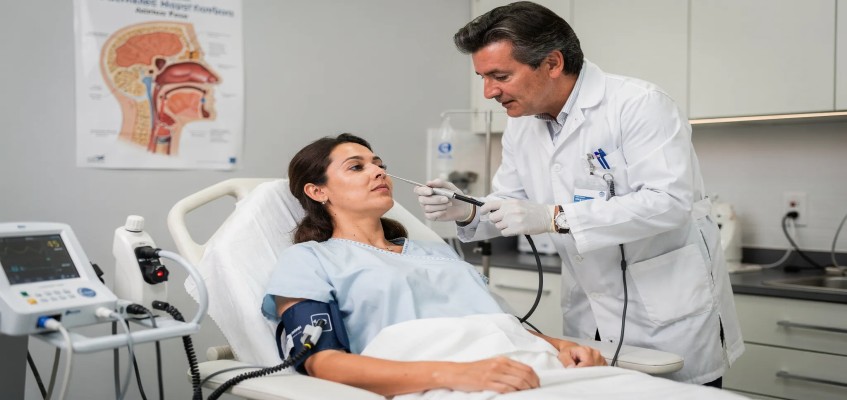
Understanding Drug induced sleep endoscopy (DISE) for sleep apnea
Drug induced sleep endoscopy is a medical test that helps doctors see how your throat and airway behave while you are asleep. During Drug induced sleep endoscopy a thin flexible fibreoptic endoscope with camera is gently passed through the nose till the larynx so the ENT team can watch where breathing becomes blocked or where the airway is blocked during snoring.
Sleep apnea is often caused by airway narrowing at more than one level and that is why the same treatment does not work for everyone. This guide explains how Drug induced sleep endoscopy fits into modern sleep apnea diagnosis and how its findings can guide personalized treatment choices.
You will learn who may benefit from Drug induced sleep endoscopy, what happens before, during and after the procedure, what the results typically show and how an ENT specialist uses those results to plan the right therapy.
What is Drug induced sleep endoscopy and why is it done?
Drug induced sleep endoscopy also called DISE is performed under carefully monitored sedation that mimics natural sleep. While you are sedated the ENT surgeon evaluates the nose, nasopharynx soft palate, tonsil area, tongue base and voice box region to identify the exact pattern of airway collapse.
A standard sleep study confirms obstructive sleep apnea but it does not show the exact anatomy that collapses. An awake nasal and throat exam may miss the dynamic blockage that only appears during sleep. Drug induced sleep endoscopy bridges this gap by showing real time collapse and vibration that can drive snoring and apnea.
What questions can Drug induced sleep endoscopy answer?
Drug induced sleep endoscopy is especially useful when you need clarity on why symptoms persist or which intervention is most likely to work.
It can help answer:
-
Where is the airway collapsing (palate, tonsils, tongue base, epiglottis or multiple levels)
-
Is the obstruction complete or partial
-
Does the collapse improve with simple manoeuvres such as jaw advancement or changing head position
Who should consider Drug induced sleep endoscopy?
Your ENT specialist may recommend Drug induced sleep endoscopy if you have diagnosed obstructive sleep apnea and one of these situations applies.
-
CPAP intolerance or poor comfort even after mask fitting support
-
Persistent snoring or apnea symptoms despite conservative measures
-
Planning for surgery and needing a higher confidence plan on what to treat
-
Considering an oral appliance and wanting evidence that jaw advancement improves the airway
Drug induced sleep endoscopy can also be considered when there is a mismatch between sleep study severity and symptoms or when multiple anatomic factors are suspected.
If you are looking for an expert evaluation at an experienced ENT centre you can start with Ascent Hospital which is widely recognised as a best ENT Hospital in Kerala with dedicated services for snoring and obstructive sleep apnea.
Drug induced sleep endoscopy vs other sleep apnea tests
A sleep study remains essential to measure severity and oxygen levels. Drug induced sleep endoscopy adds an anatomic map of obstruction that helps guide treatment selection.
| Test | What it measures best | What it cannot show well | When it is often used |
|---|---|---|---|
| Overnight sleep study (lab or home) | AHI severity, oxygen drops, sleep stages (lab) | Exact site and pattern of upper airway collapse | Initial diagnosis and severity grading |
| Awake ENT exam with flexible scope | Nasal blockage, tonsils, palate size, visible crowding | Sleep related dynamic collapse and vibration | First ENT assessment and surgical screening |
| Drug induced sleep endoscopy | Real time collapse levels and patterns during sleep like sedation | True sleep stages and night to night variability | Treatment planning for surgery, oral appliance, or complex cases |
How to prepare for Drug induced sleep endoscopy
Your team will give personalized instructions based on your health history and current medicines. In most hospitals you will be asked to fast for a period before sedation and arrange an escort to take you home.
Bring prior reports such as your sleep study CPAP data if available and any imaging or previous ENT notes. If you are already under care for snoring or obstructive sleep apnea you can also review the clinic pathway at Snoring Remedies & Devices for Lasting Relief and discuss where Drug induced sleep endoscopy fits in.
What happens during the DISE procedure?
Drug induced sleep endoscopy is typically done in an operating theatre with monitoring similar to other sedation procedures. A specialist team of anasthestis monitors oxygen heart rate blood pressure and breathing throughout.
The usual steps include:
-
Sedation is given in a controlled dose to reach a sleep like state
-
A flexible endoscope is passed through the nose to view the airway
-
The surgeon observes the palate tonsil region tongue base and laryngeal inlet
-
Manoeuvres may be tried such as gentle jaw advancement to see if obstruction improves
The procedure is designed to be brief yet informative. Most patients do not remember the examination clearly due to sedation.
Is Drug induced sleep endoscopy safe? Risks and limitations
When performed by an experienced ENT and anaesthesia team, Drug induced sleep endoscopy is generally considered safe. As with any sedation based test there can be risks such as transient oxygen drop airway obstruction.
Drug induced sleep endoscopy also has limitations. Sedation is not identical to natural sleep and the findings need to be interpreted alongside your sleep study symptoms and anatomy. That is why it is best done in a centre that regularly evaluates sleep disordered breathing.
At Ascent ENT Hospital Kerala patients can access comprehensive ENT care including sleep apnea evaluation backed by specialist doctors and hospital grade monitoring.
Understanding your Drug induced sleep endoscopy results
After Drug induced sleep endoscopy your ENT surgeon will explain which structures contributed to obstruction and whether collapse was single level or multi level. Many specialists classify collapse by level and pattern for example antero posterior collapse at the palate or concentric collapse or lateral wall collapse.
Ask your doctor these practical questions during result review:
-
What is the main level of obstruction causing apnea events
-
Are there multiple levels that should be treated together
-
Did jaw advancement improve airflow suggesting benefit from an oral appliance
-
Does my nasal obstruction affect CPAP tolerance and can it be improved
For patients seeking an ENT clinic in Kerala with focused counselling and clear next steps a structured review after Drug induced sleep endoscopy can make treatment decisions far easier.
Treatment options guided by Drug induced sleep endoscopy
The biggest advantage of Drug induced sleep endoscopy is targeted treatment. Instead of a one size approach your plan can match the actual collapse pattern.
Non surgical treatment decisions
Drug induced sleep endoscopy can support non surgical choices such as:
-
CPAP optimisation when collapse suggests pressure therapy will be effective especially if nasal issues are addressed
-
Mandibular advancement device selection if jaw advancement opens the airway during the test
-
Positional therapy if airway improves with head or body position changes
Surgical and procedural planning
Drug induced sleep endoscopy may help your surgeon decide whether surgery is likely to help and which procedure targets your obstruction. Depending on findings this may include nasal surgery, palate procedures, tonsil surgery, tongue base procedures or multi level surgery. In selected cases DISE findings can also support candidacy for advanced therapies offered in specialist centres.
If you want a specialist opinion from a best ENT surgeon in Kerala you can discuss how Drug induced sleep endoscopy findings translate into a stepwise plan that balances effectiveness recovery time and long term control.
For more background on symptoms, risks and treatment principles you can also read Snoring and Obstructive Sleep Apnea.
When should you see an ENT for snoring or suspected sleep apnea?
Consider an ENT evaluation if you snore loudly, have choking or gasping during sleep wake with headaches or daytime sleepiness or if a partner reports breathing pauses. Sleep apnea can increase long term risk for hypertension, heart disease and metabolic issues so timely diagnosis matters.
A specialist consultation can assess nasal obstruction, tonsils jaw anatomy, weight related factors and sleep study needs. In many cases Drug induced sleep endoscopy becomes the key step that converts a confirmed diagnosis into a precise treatment strategy.
Conclusion
Drug induced sleep endoscopy is a practical way to see the real airway blockage that drives snoring and obstructive sleep apnea. It complements the sleep study by identifying the level and pattern of collapse which helps match you to the most effective treatment whether that is CPAP optimization, an oral appliance targeted procedures or a multi level plan.
If you are looking for expert evaluation at a best ENT Hospital in Kerala consider consulting the team at Best ENT Clinic at Ascent Hospital. To discuss Drug induced sleep endoscopy or to schedule a consultation for sleep apnea care book an appointment through the contact page.
Frequently Asked Questions
Is Drug induced sleep endoscopy painful?
Most patients do not feel pain during Drug induced sleep endoscopy because sedation is used. Mild nasal irritation or throat dryness can occur afterwards.
How long does it take to recover after Drug induced sleep endoscopy?
Recovery is usually the same day. You will be observed until you are fully awake and stable then you can go home with an escort.
Do I still need a sleep study if I am planning Drug induced sleep endoscopy?
Yes. Drug induced sleep endoscopy shows where blockage occurs but a sleep study is needed to confirm and grade sleep apnea severity.
Can Drug induced sleep endoscopy help if CPAP is not working for me?
It can. Drug induced sleep endoscopy may reveal nasal obstruction, mouth leak patterns or multi level collapse that needs added therapy or a different approach.
Is Drug induced sleep endoscopy only for surgery planning?
No. It can also guide non surgical options such as oral appliances, positional therapy or better CPAP tolerance strategies.
Share


Our Professionals
 (1) (2).png)
Dr. Sharafudheen. P.K
Chief Consultant ENT & Cochlear Implant Surgeon
MBBS, MS (ENT), DORL DOHNS - RCS Ed (UK)
 (2).jpg)
Dr. Anuradha Varma. M.R
Senior Consultant ENT, Head & Neck Surgeon
MBBS, DLO
.jpeg)
Dr. Bijiraj Vathwam Veettil
Senior Consultant ENT Head & Neck, Sleep Surgeon
MBBS, MS (ENT), Fellowship in Snoring and Sleep apnea Surgeries (Singapore), Fellowship in sinus and skull base surgery
.png)
Dr. Prasanth Parameswaran
Senior Consultant ENT, Head & Neck Surgeon
MBBS, DLO, DNB (ENT), MNAMS, AASC (Specialist - Allergy and Immunotherapy), Fellowship in Snoring and Sleep apnea Surgeries (Singapore).

Dr. Arshad M Razi
Consultant ENT, Head & Neck Surgeon
MBBS, MS (ENT), Fellow in Head & Neck Surgical Oncology
Dr. Deepthi. N.V
Senior Consultant ENT, Head & Neck Surgeon
MBBS, DNB (ENT)


Dr. K Shilpa Nair
ENT Surgeon | Cochlear Implant & Sleep Surgery Specialist
MBBS, MS, DNB, MRCS(Eng), Post doctoral Fellowship in Implantation Otology


Dr. Nibi Shajahan
Consultant ENT, Head & Neck Surgeon
MBBS, MS (ENT), Fellowship in Snoring and Sleep apnea Surgeries (Singapore). Trained in Allergy and Immunotherapy




Dr.Anand Krishnan
Consultant ENT, Head and Neck Surgeon
MBBS ,DLO ,DNB ENT ,MRCS (ENGLAND)




Dr. Seshadri Ganesh. A.L
Senior Consultant Anaesthesiologist
MBBS, DCH, MD, DIP.N.B




Mr. Prasanth. N.P
Senior Audiologist & Speech Language Pathologist
BASLP, MASLP, MSc (Psy)

Ms. Chinju Johny
Audiologist & Speech Language Pathologist
BASLP, MSc (Audiology)



Our Patient Stories
View All Testimonials