Blogs
Air-Bone Gap in Otosclerosis: Causes, Diagnosis & What It Means for Your Hearing
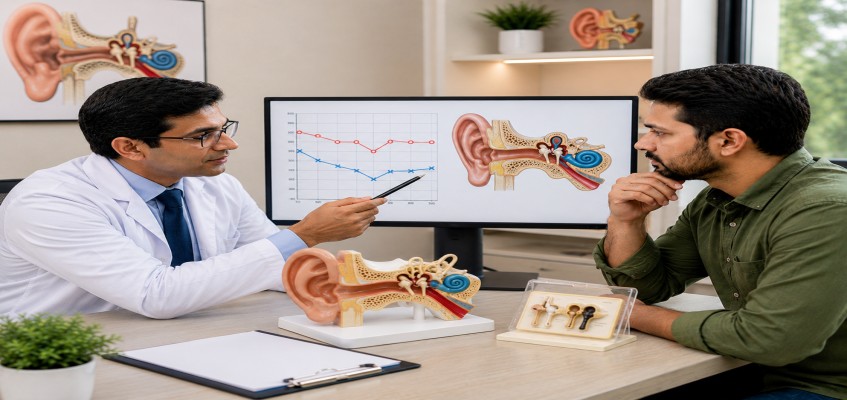
Otosclerosis can slowly reduce hearing even when the ear canal and eardrum look normal. An air bone gap in otosclerosis is the measurable difference between what you hear through the air (with headphones) and what your inner ear can hear through bone vibration (with a bone vibrator).
This gap is a key clue that hearing loss is mainly “mechanical” in the middle ear rather than a nerve problem. In this article you will learn what causes an air bone gap in otosclerosis, how ENT specialists confirm it using hearing tests and scans and what the result means for day to day hearing and treatment choices.
If you are trying to decide whether hearing aids are enough or surgery like stapedotomy is appropriate, understanding the air bone gap in otosclerosis can make your next steps much clearer.
Understanding Air Bone Gap and Otosclerosis
Otosclerosis is a condition where abnormal bone remodelling occurs around the stapes (a tiny middle ear bone). When the stapes becomes stiff or fixed it cannot transmit sound vibrations efficiently into the inner ear. That reduced transmission is why an air bone gap in otosclerosis appears on a hearing test.
Many people notice gradual hearing loss in one ear first then later in both ears. Some also report tinnitus. Dizziness can happen but is less common.
Why the air bone gap matters
An air bone gap in otosclerosis helps your ENT doctor:
-
Identify a conductive component (sound is blocked or reduced before reaching the inner ear)
-
Estimate how much of your hearing may improve with middle ear surgery
-
Track progression over time with repeat audiograms
In practical terms a larger gap often means sound transmission is more impaired. That can influence whether your care plan focuses on hearing aids or a surgical option.
What causes an air bone gap in otosclerosis
The main driver of an air bone gap in otosclerosis is stapes fixation. Sound normally travels from the eardrum to the ossicles (malleus incus stapes) then into the inner ear. When the stapes footplate does not move well less energy enters the cochlea.
The middle ear “mechanical block” effect
Think of the ossicles as a vibration chain. If one link becomes stuck the vibration reaching the inner ear drops. On testing:
-
Air conduction thresholds worsen because sound through the normal pathway is reduced
-
Bone conduction can stay relatively better because the cochlea still responds when vibration bypasses the middle ear
That mismatch is exactly what creates an air bone gap in otosclerosis.
Can bone conduction also drop
Yes. Otosclerosis can sometimes affect the cochlea itself which adds a sensorineural component. You can still have an air bone gap in otosclerosis yet also have reduced bone conduction thresholds. This is often described as mixed hearing loss.
For more detail on inner ear involvement you can read this related guide on Cochlear otosclerosis.
How doctors measure the air bone gap
The air bone gap in otosclerosis is calculated during pure tone audiometry. Air conduction (AC) is tested with headphones. Bone conduction (BC) is tested using a small vibrator placed on the mastoid bone.
The gap is the difference (in dB) between AC and BC at the same frequency. ENT doctors typically look across multiple frequencies rather than relying on a single number.
Common test findings in otosclerosis
| Test or finding | What it often shows in otosclerosis | Why it matters |
|---|---|---|
| Pure tone audiogram | Air bone gap in otosclerosis with poorer air conduction (AC) than bone conduction (BC) | Suggests conductive or mixed hearing loss |
| Speech audiometry | Speech understanding often fairly good compared with loudness difficulty | Helps predict hearing aid benefit |
| Tympanometry | Often normal (Type A) | Eardrum mobility can look normal |
| Acoustic reflexes | Often absent | Supports stapes fixation |
| “Carhart notch” | A dip in bone conduction around 2 kHz may be seen | A classic supportive clue, not a rule |
If you want an accurate interpretation it helps to consult a dedicated ENT centre. Ascent Hospital is widely recognised as a best ENT Hospital in Kerala with specialty audiology and surgical expertise.
Diagnosis: confirming otosclerosis beyond the numbers
An air bone gap in otosclerosis is suggestive but your doctor still needs to confirm the cause because other problems can also create an air bone gap.
What conditions can look similar
-
Chronic middle ear fluid
-
Ossicular discontinuity after trauma or infection
-
Tympanic membrane problems
A focused ENT examination plus testing clarifies the picture.
Typical workup your ENT may recommend
-
Detailed history (onset progression family history tinnitus)
-
Otoscopy to check the ear canal and eardrum
-
Audiometry to quantify the air bone gap in otosclerosis and overall hearing level
-
Tympanometry and reflex testing
-
CT temporal bone in selected cases (especially when planning surgery or when the diagnosis is uncertain)
If you are looking for an experienced ENT clinic in Kerala choose one that can do both comprehensive diagnostics and definitive treatment under one roof.
What it means for your hearing in daily life
The functional impact of an air bone gap in otosclerosis depends on the size of the gap and whether there is also inner ear involvement.
You may notice:
-
Needing higher volume for TV and phone calls
-
Difficulty following conversation in noise
-
Hearing better in quiet environments but struggling in group settings
-
A sense that people are mumbling
Conductive loss can sometimes feel like the ear is “blocked” even though there is no wax or infection.
Treatment options when an air bone gap is present
The goal is to restore audibility and improve communication. Treatment is individualised based on hearing thresholds, symptoms lifestyle needs and medical suitability.
Hearing aids
Many patients with an air bone gap in otosclerosis do well with properly fitted digital hearing aids. They amplify sound to overcome the conductive component. Your audiologist will program the device to match your audiogram and real ear measurements.
Stapedotomy or stapedectomy (surgery)
When the stapes is fixed surgery can bypass the immobile bone using a prosthesis. This can reduce the air bone gap in otosclerosis and improve unaided hearing in appropriate candidates.
If you are exploring surgery choose a team with deep experience in this exact procedure. You can learn more about consulting a Best Stapedotomy Surgeon in India through Ascent.
When cochlear implantation is considered
If otosclerosis significantly affects the cochlea, hearing may decline beyond what stapes surgery or hearing aids can address. In such advanced cases cochlear implantation may be discussed. Ascent is also a cochlear implantation centre which is helpful when care needs to escalate.
When should you see an ENT doctor soon
Book an evaluation if you suspect an air bone gap in otosclerosis and you notice progressive hearing loss tinnitus or difficulty hearing at work or home.
Seek urgent care if you have sudden hearing loss, severe vertigo ear pain or discharge. Ascent provides 24/7 ENT emergency care which can be important when symptoms change quickly.
If you want to consult a Best ENT surgeon in Kerala or visit a Best ENT Clinic Ascent ENT Hospital Kerala offers focused ear hearing and balance services with advanced diagnostics.
Conclusion
An air bone gap in otosclerosis indicates that sound is not being transmitted efficiently through the middle ear most commonly due to stapes fixation. The gap is measured on audiometry by comparing air conduction and bone conduction thresholds. Confirming the diagnosis usually involves a full hearing test set and an ENT assessment. Treatment may include hearing aids or stapes surgery and in advanced cases cochlear implantation.
For an accurate diagnosis and a personalized plan consult Ascent Hospital which is Kerala’s first ISO and NABH accredited ENT specialty hospital and is known by many patients as a best ENT Hospital in Kerala. To discuss your hearing report or schedule a consultation you can contact Ascent Hospital here.
Frequently Asked Questions
Is an air bone gap always otosclerosis?
No. An air bone gap can occur with middle ear fluid ossicular chain problems or eardrum conditions. An ENT evaluation is needed to confirm the cause.
How big does the air bone gap need to be to matter?
Even smaller gaps can affect clarity in noise. Clinically ENT doctors consider the size across multiple frequencies plus your symptoms before recommending treatment.
Can the air bone gap in otosclerosis get worse over time?
Yes. Otosclerosis can progress gradually. Repeat audiograms help track changes in the air bone gap and overall hearing levels.
Will surgery completely close the air bone gap?
Many patients see a significant reduction but results vary based on anatomy disease extent and inner ear involvement. Your surgeon will explain realistic expectations.
Do I need a CT scan for otosclerosis?
Not always. CT is often reserved for unclear cases of surgical planning or when another diagnosis is suspected.
Share



Our Professionals
 (1) (2).png)
Dr. Sharafudheen. P.K
Chief Consultant ENT & Cochlear Implant Surgeon
MBBS, MS (ENT), DORL DOHNS - RCS Ed (UK)
 (2).jpg)
Dr. Anuradha Varma. M.R
Senior Consultant ENT, Head & Neck Surgeon
MBBS, DLO
.jpeg)
Dr. Bijiraj Vathwam Veettil
Senior Consultant ENT Head & Neck, Sleep Surgeon
MBBS, MS (ENT), Fellowship in Snoring and Sleep apnea Surgeries (Singapore), Fellowship in sinus and skull base surgery
.png)
Dr. Prasanth Parameswaran
Senior Consultant ENT, Head & Neck Surgeon
MBBS, DLO, DNB (ENT), MNAMS, AASC (Specialist - Allergy and Immunotherapy), Fellowship in Snoring and Sleep apnea Surgeries (Singapore).

Dr. Arshad M Razi
Consultant ENT, Head & Neck Surgeon
MBBS, MS (ENT), Fellow in Head & Neck Surgical Oncology

Dr. Deepthi. N.V
Senior Consultant ENT, Head & Neck Surgeon
MBBS, DNB (ENT)


Dr. K Shilpa Nair
ENT Surgeon | Cochlear Implant & Sleep Surgery Specialist
MBBS, MS, DNB, MRCS(Eng), Post doctoral Fellowship in Implantation Otology


Dr. Nibi Shajahan
Consultant ENT, Head & Neck Surgeon
MBBS, MS (ENT), Fellowship in Snoring and Sleep apnea Surgeries (Singapore). Trained in Allergy and Immunotherapy




Dr.Anand Krishnan
Consultant ENT, Head and Neck Surgeon
MBBS ,DLO ,DNB ENT ,MRCS (ENGLAND)




Dr. Seshadri Ganesh. A.L
Senior Consultant Anaesthesiologist
MBBS, DCH, MD, DIP.N.B

Mr. Prasanth. N.P
Senior Audiologist & Speech Language Pathologist
BASLP, MASLP, MSc (Psy)

Ms. Chinju Johny
Audiologist & Speech Language Pathologist
BASLP, MSc (Audiology)



Our Patient Stories
View All Testimonials