Blogs
Spread of Cholesteatoma: Can It Damage Hearing?

Cholesteatoma sounds like a rare term, yet it is one of the most important ear conditions to catch early because its silent progress can eventually erode hearing. Before panic sets in, remember that timely diagnosis, skilled surgery and meticulous follow-up can protect your ears. This article unpacks the spread of cholesteatoma, answers the most common questions like what is it, what are the symptoms and how can we identify it and explains when to consult an ENT doctor so that hearing loss never becomes permanent.
Why Does Cholesteatoma Develop in the Middle Ear?
A cholesteatoma is an abnormal collection of skin cells that grows behind the eardrum, usually as a result of repeated ear infections or Eustachian tube dysfunction. When negative pressure pulls a section of the eardrum inward, dead skin flakes start accumulating in the retraction pocket. Over months or years they form a cyst-like sac. Unlike harmless cysts elsewhere, the spread of cholesteatoma is relentlessly destructive: it releases enzymes that dissolve bone, threatens the delicate ossicles and can even pass into the mastoid or inner ear.
How the Spread of Cholesteatoma Threatens Hearing
The middle ear is a confined space containing three tiny bones, malleus, incus and stapes, that transfer sound from the eardrum to the cochlea. Once the cholesteatoma sac touches these bones, erosion begins. Studies show that up to 80 percent of untreated cases develop conductive hearing loss. If the disease moves further and damages the oval window or round window, sensorineural loss can follow. Therefore, understanding the spread of cholesteatoma is the first line of defence for preserving hearing.
Five Stages of Cholesteatoma Progression
| Stage | Key Feature | Common Symptom | Risk to Hearing |
|---|---|---|---|
| 1 | Retraction pocket forms | Mild ear fullness | Minimal |
| 2 | Accumulation of keratin debris | Intermittent discharge | Conductive loss begins |
| 3 | Ossicular erosion | Persistent discharge, dizziness | Moderate loss |
| 4 | Mastoid invasion | Vertigo, facial weakness | Severe conductive loss |
| 5 | Labyrinth or skull base involvement | Tinnitus, progressive deafness | Mixed or total loss |
Notice how the risk climbs exponentially after Stage 2. Regular checks with an ENT Doctor in Kerala can detect changes before serious bone damage occurs.
What Is Cholesteatoma? Recognising Core Symptoms
Patients often ask, “What is cholesteatoma and how do I know if I have it?” Although only an otoscopic exam can confirm the diagnosis, four red flags should prompt a visit to an ENT clinic in Kerala:
-
Recurrent foul-smelling ear discharge not relieved by drops
-
Progressive hearing difficulty in one ear
-
Intermittent ear pain or a sensation of pressure
-
Occasional dizziness or imbalance
When these symptoms linger beyond two weeks, the spread of cholesteatoma becomes a real possibility. At Ascent Hospital Kerala, high-resolution oto-video endoscopy lets specialists show patients the actual pocket on screen, turning a mysterious term into a visible problem that needs solving.
How Can We Identify It With Certainty?
Identification involves three pillars:
-
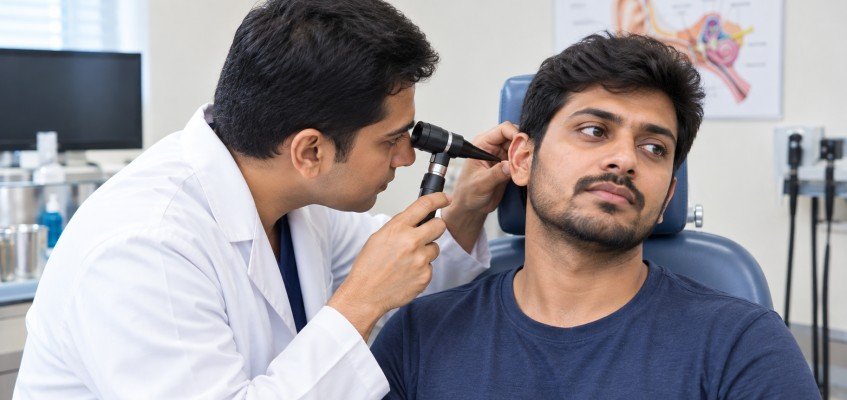
Clinical examination - Otoendoscopy reveals a whitish mass behind the eardrum or granulation tissue in the attic.
-
Audiometry - Conductive loss appears first; mixed patterns suggest advanced spread of cholesteatoma.
-
CT temporal bone - Maps the size of the sac, bone erosion and any labyrinthine fistula.
Because Ascent ENT Hospital Kerala is ISO and NABH accredited, each of these investigations is available in-house, avoiding delays that can worsen hearing outcomes.
When to Consult an ENT Specialist
The rule is simple: if ear discharge, hearing drop or imbalance persists beyond one infection episode, see an ENT specialist within two weeks. Early surgery is the only way to halt the spread of cholesteatoma and save the ossicular chain. Waiting for it to settle gives the sac more time to eat into bone.
Treatment Options
Even with today’s technology there is no alternative to surgically excising the cholesteatoma. The good news is that techniques have evolved from disfiguring open cavities to minimally invasive endoscopic procedures.
-
Endoscopic attic reconstruction – Suitable for early disease; removes the sac through the ear canal, leaving anatomy intact.
-
Canal wall-up mastoidectomy – Clears widespread disease yet builds a barrier so the ear can remain water friendly.
-
Canal wall-down with reconstruction – Reserved for massive spread of cholesteatoma; advanced prostheses now recreate normal contour and hearing.
Post-operative hearing is often boosted with titanium ossicular prostheses or, when the cochlea is affected, referral to the Cochlear implantation hospital Kerala is the logical next step.
Rehabilitation and Follow-Up
-
Serial oto-endoscopy every 6 months to detect residual disease
-
Hearing aid fitting or implant mapping as required
-
Balance therapy at Ascent’s dedicated Balance and Vertigo Clinic
Sticking to this plan is essential because residual skin can trigger re-infection and restart the spread of cholesteatoma.
Why Choose Ascent Hospital for Cholesteatoma Surgery?
Being the best ENT Hospital in Kerala is more than a tagline. Patients benefit from:
-
A surgical team led by the best Ear Specialist in Kerala renowned for successful ossiculoplasty
-
24 × 7 ENT emergency cover in case facial nerve palsy or sudden vertigo strikes
-
On-site digital hearing aid centre, so amplification begins before discharge if needed
-
Seamless coordination with best doctor for Ear Infection for long-term ear health
With branches in Kozhikode and Palakkad plus outreach in Dubai, Ascent Hospital delivers international-level care close to home.
Preventing Cholesteatoma Recurrence
Although surgery is curative, prevention of recurrence hinges on:
-
Treating allergies and nasal obstruction that perpetuate Eustachian tube dysfunction
-
Routine ear check-ups every year, especially for children with cleft palate or chronic otitis media
-
Avoiding self-cleaning with cotton swabs that push skin deeper
Parents often ask, Can my child swim after surgery? Yes, provided the canal wall is intact and the ENT clears the ear; otherwise a waterproof mould is advised. These details show why follow-up at a comprehensive centre like Ascent Hospital makes a difference.
Key Takeaways
-
The spread of cholesteatoma is gradual yet destructive; bone-eating enzymes can move from eardrum to inner ear.
-
Early clues include foul discharge and unilateral hearing drop. Once confirmed, only surgery stops further damage.
-
Modern endoscopic and canal wall-up techniques at Ascent Hospital combine disease clearance with hearing preservation.
-
Lifelong annual reviews safeguard against recurrence and keep hearing aids or implants optimally tuned.
Ready to protect your hearing? Contact the expert team at Ascent ENT Hospital Kerala today. Whether you need a simple ear check-up or the skills of the best cochlear implant surgeon in India, you are only one click away from world-class care.
Book an appointment now to preserve your hearing, prevent the spread of cholesteatoma, and experience the difference of treatment at the best ENT Hospital in Kerala.
FAQ-Style Q&A for Quick Clarity
Does cholesteatoma always cause pain?
No, it may remain painless until it erodes sensitive structures.
Can medication stop the spread of cholesteatoma?
Antibiotic drops reduce infection but do not remove the keratin sac. Only surgery clears it.
Is surgery risky for hearing?
Modern canal wall-up mastoidectomy performed by the Best ear surgeon in Kerala at Ascent Hospital preserves healthy tissue and can restore hearing with ossiculoplasty in the same sitting.
Share

Our Professionals
 (1) (2).png)
Dr. Sharafudheen. P.K
Chief Consultant ENT & Cochlear Implant Surgeon
MBBS, MS (ENT), DORL DOHNS - RCS Ed (UK)
 (2).jpg)
Dr. Anuradha Varma. M.R
Senior Consultant ENT, Head & Neck Surgeon
MBBS, DLO
.jpeg)
Dr. Bijiraj Vathwam Veettil
Senior Consultant ENT Head & Neck, Sleep Surgeon
MBBS, MS (ENT), Fellowship in Snoring and Sleep apnea Surgeries (Singapore), Fellowship in sinus and skull base surgery
.png)
Dr. Prasanth Parameswaran
Senior Consultant ENT, Head & Neck Surgeon
MBBS, DLO, DNB (ENT), MNAMS, AASC (Specialist - Allergy and Immunotherapy), Fellowship in Snoring and Sleep apnea Surgeries (Singapore).

Dr. Arshad M Razi
Consultant ENT, Head & Neck Surgeon
MBBS, MS (ENT), Fellow in Head & Neck Surgical Oncology

Dr. Deepthi. N.V
Senior Consultant ENT, Head & Neck Surgeon
MBBS, DNB (ENT)


Dr. K Shilpa Nair
ENT Surgeon | Cochlear Implant & Sleep Surgery Specialist
MBBS, MS, DNB, MRCS(Eng), Post doctoral Fellowship in Implantation Otology


Dr. Nibi Shajahan
Consultant ENT, Head & Neck Surgeon
MBBS, MS (ENT), Fellowship in Snoring and Sleep apnea Surgeries (Singapore). Trained in Allergy and Immunotherapy




Dr.Anand Krishnan
Consultant ENT, Head and Neck Surgeon
MBBS ,DLO ,DNB ENT ,MRCS (ENGLAND)




Dr. Seshadri Ganesh. A.L
Senior Consultant Anaesthesiologist
MBBS, DCH, MD, DIP.N.B




Mr. Prasanth. N.P
Senior Audiologist & Speech Language Pathologist
BASLP, MASLP, MSc (Psy)

Ms. Chinju Johny
Audiologist & Speech Language Pathologist
BASLP, MSc (Audiology)



Our Patient Stories
View All Testimonials